

 Last Updated – September 6, 2026
 Read Time – Est:
Schedule a confidential consultation with an experienced Colorado Springs domestic violence lawyer.
If you have been accused of domestic violence in Colorado Springs, it is important to secure experienced legal help right away. These cases move quickly, and an arrest often comes with a protection order that limits where you can go and whom you can contact. Our Colorado Springs, CO domestic violence lawyer has defended people in this position for more than two decades, including years as a former prosecutor. We give honest counsel and a steady plan, and our consultations are free and confidential.
Domestic Violence Lawyer Colorado Springs, CO
 A domestic violence lawyer defends people accused of an offense that the state treats as domestic violence. In Colorado, domestic violence is not a separate crime so much as a designation attached to an underlying offense, such as assault, harassment, or menacing, when it involves an intimate relationship, and that designation brings added consequences.
What surprises many people is how fast the process moves and how little it takes to set it in motion. An accusation can lead to an arrest, and an arrest in these cases often comes with a mandatory protection order that affects where you can go and whom you can contact. The case proceeds even when the accuser later wants it dropped, because the decision rests with the prosecution, not the alleged victim. A Colorado Springs domestic violence attorney understands these dynamics and works to protect your rights from the first day.
These cases are also deeply personal, and they are often built on conflicting accounts. We approach them with the seriousness they demand and without judgment about how you ended up here.
It’s worth understanding why the system reacts the way it does. After years of public attention to domestic violence, police and prosecutors are trained to err on the side of arrest and to push cases forward aggressively. That can be the right instinct in some situations and the wrong one in others, and the people caught in the middle are often left without a clear voice. Part of our job is to make sure your side of the story is heard, fully and fairly, rather than reduced to a few lines in an officer’s report written in the heat of the moment.
Types of Domestic Violence Cases We Handle in Colorado Springs
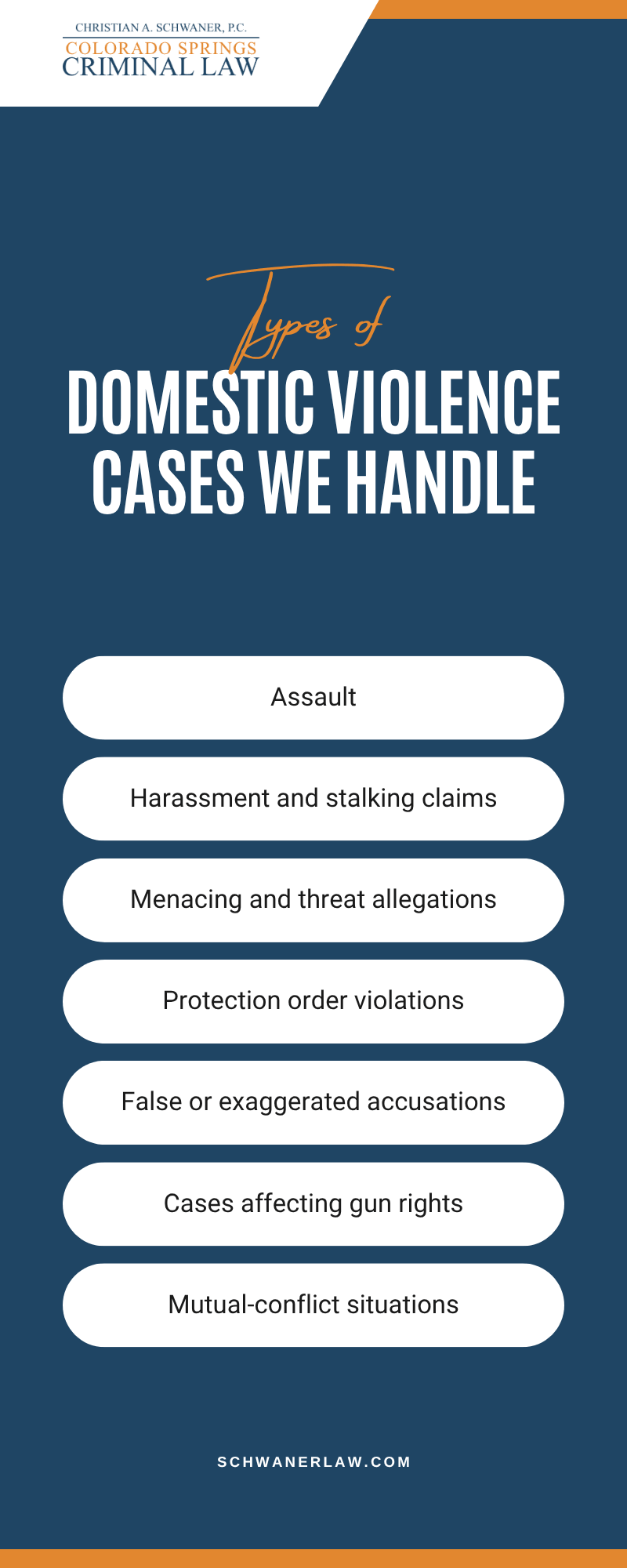
 Domestic violence allegations cover a wide range of conduct, and the underlying charge shapes the defense. Some cases rest on physical allegations. Others involve words, messages, or disputed accounts of a single heated moment. These are the matters we handle most often for clients across the Colorado Springs area.
- Assault. When an assault charge carries a domestic violence designation, the stakes rise. We examine the injuries, the witnesses, and whether self-defense applies. The same incident can look very different once the full context is laid out rather than just the moment police arrived.
- Harassment and stalking claims. These cases often turn on messages, calls, and patterns of contact. We look closely at the context and whether the conduct meets the legal standard.
- Menacing and threat allegations. Accusations involving threats or intimidation can escalate quickly, sometimes into felony menacing territory. We treat these charges with the weight they carry.
- Protection order violations. A mandatory protection order can be easy to violate by accident, and a violation creates a new charge. We help clients understand and comply while we fight the underlying case.
- False or exaggerated accusations. Some domestic violence claims arise from custody disputes, breakups, or anger. We take false accusations seriously and build the record needed to challenge them.
- Cases affecting gun rights. A domestic violence matter can carry firearm consequences that follow you for years. We address the gun rights implications as part of the defense.
- Mutual-conflict situations. Many incidents involve two people and competing stories. We work to present the full picture rather than the one-sided version in a police report, since officers usually have to pick someone to arrest and don’t always pick correctly.
Each case is different, and the strategy depends on the underlying charge, the evidence, and the relationship involved. We don’t treat any of them as routine.
Why Choose Christian A. Schwaner, P.C. as my Domestic Violence Lawyer in Colorado Springs, CO?
 A Former Prosecutor Who Knows These Cases
Attorney Christian Schwaner has defended domestic violence cases in Colorado for more than 20 years. Before that, he prosecuted criminal cases as a Deputy District Attorney in El Paso and Teller Counties, which means he has seen how these matters are charged and pursued from the inside. That perspective informs our work as a criminal defense lawyer in Colorado Springs, CO. We know how the state builds a domestic violence case, and we know where those cases are often weakest.
Honest Guidance in a High-Pressure Moment
These cases move fast and feel overwhelming, and clients need straight answers, not false comfort. Mr. Schwaner provides realistic assessments rather than false promises, and he’s known for being directly accessible to the people he represents. He’s a member of the Colorado Bar Association and the Colorado Criminal Defense Bar. Consultations are confidential and free, so you can get clear guidance about what comes next. In a moment when everything feels uncertain, having a single, reliable source of honest information can make a real difference.
Understanding Domestic Violence Cases
 Charges, Penalties, and Defense Strategies for Domestic Violence Cases
You don’t need to know the statutes to understand how a domestic violence case works. A few realities shape almost every one:
- A designation, not a standalone charge. Domestic violence attaches to an underlying offense and brings added requirements and consequences.
- A protection order, often automatic. Many cases come with a mandatory protection order from the start.
- The state controls the case. The prosecution decides whether to proceed, even if the accuser wants it dropped.
- Collateral consequences. A conviction can affect firearm rights, housing, employment, and family matters.
- Defenses exist. Self-defense, conflicting accounts, and weak evidence all create room to fight.
Our approach begins with what the law actually requires, which is why understanding domestic violence defined in Colorado matters so much. The consequences of conviction are serious enough that no one should face these charges without counsel, and they reach well beyond any sentence the court imposes.
What Are Important Aspects of a Domestic Violence Case?
The outcome of these cases often turns on details that don’t appear in the initial police report, and we give those details close attention.
- Whether the physical evidence matches the account given.
- Whether the witnesses are consistent and credible.
- Whether self-defense or mutual conduct is in play.
- How the protection order affects your daily life and your case.
These factors can change the entire trajectory of a case. We investigate them carefully rather than accepting the first version of events, because the account in a police report is rarely the whole story.
What Is The Domestic Violence Case Timeline?
A domestic violence case follows a recognizable path, often beginning with an arrest and a protection order. Knowing the stages helps you prepare for what’s ahead.
- Arrest and the issuance of a mandatory protection order.
- An early court appearance addressing the order and conditions.
- The exchange of evidence and investigation.
- Negotiation, motions, and case development.
- Resolution by plea, dismissal, or trial.
The early hearings can shape your living situation and your contact with family, which is why having counsel from the outset matters. Knowing what facing a DV charge involves helps you avoid costly missteps, particularly around the protection order, where an innocent phone call can become a new charge.
What Should You Bring to Your Domestic Violence Consultation?
The more you can share, the more useful our guidance will be. If you have these, bring them to the first meeting:
- Any arrest or charging paperwork you received.
- A copy of any protection order.
- Records of communication relevant to the accusation.
- A written timeline of what happened while it’s fresh.
Expect a confidential and judgment-free conversation. We’ll explain how the case may unfold and the right steps to take after a domestic dispute.
What Are Important Colorado Legal Resources for Domestic Violence Cases?
 You shouldn’t have to navigate this system alone. These public resources can help you understand the courts and laws involved in a Colorado domestic violence case, though none of them replace advice from a lawyer who knows your facts.
- The Colorado Revised Statutes contain the state’s criminal laws and domestic violence provisions.
- The El Paso County self-help center provides Fourth Judicial District court information.
- Statewide Colorado court self-help resources offer forms and guidance.
- The criminal appeal process is outlined for those reviewing a result.
Reach Out to Christian A. Schwaner, P.C. to Schedule a Consultation
A domestic violence accusation is frightening, but you have rights and you have options. We offer free, confidential consultations and will give you an honest read on your case and the steps that protect you right now. Contact us to speak with a Colorado Springs domestic violence defense attorney who has handled these cases from both sides.
Colorado Springs Domestic Violence Infographic
Domestic Violence Case Statistics in Colorado Springs
 Colorado treats domestic violence cases under a distinct framework that shapes how charges are filed, prosecuted, and resolved. The DVOMB reports published by the Office of Domestic Violence and Sex Offender Management document how the state manages court-ordered treatment for individuals convicted or given deferred judgments in DV-related cases. Statewide oversight sits with the Colorado Fatality Review Board, chaired by the Attorney General, which tracks DV-related fatalities annually. Federal data through the BJS intimate partner violence topic page shows the broader national context.
Mistakes That Can Damage Your Domestic Violence Defense
Some of the strongest domestic violence cases are lost before the defense begins. What defendants do in the hours and days after arrest often matters as much as anything that happens in court later.
- Contacting the alleged victim. A mandatory protection order is almost always issued at the initial court appearance in a DV case. That order typically bars all contact, including through third parties. A well-meaning text or a friend’s call on your behalf can trigger a new charge and revoke bond, and the underlying case gets harder to defend when protection order violations pile up.
- Giving a statement to police without a lawyer. Officers responding to a DV call collect statements while emotions are high and details are unclear. Anything said at the scene or in an interview room becomes evidence. False statements carry their own separate exposure, since the offense of lying to the police is charged independently from whatever brought officers to the home.
- Discussing the case on social media or in group chats. Anything you post, text, or share about the incident, the alleged victim, or the charges can be subpoenaed. Comments that seemed private at the time appear later in discovery. The safest position is silence with everyone except your attorney.
- Ignoring protection order boundaries. Even when the alleged victim reaches out, responding violates the order. Courts have found order violations even when the alleged victim initiates contact, invites the defendant home, or claims the order should be lifted. The terms of the original order are enforceable until a judge modifies it.
- Deleting texts, photos, or social media posts. Removing communications after an arrest can be treated as tampering with evidence, and it usually looks worse than whatever was in the original messages. Preserve the record and let the defense work with what actually exists.
- Consenting to a search without a warrant. Officers frequently ask permission to search a home or phone at the scene of a DV call. Consent removes the ability to challenge that search later. Preserving 4th Amendment rights at the point of contact keeps suppression motions available if the state’s evidence came from questionable searches.
- Missing court dates or violating bond conditions. Any missed appearance or condition violation compounds the underlying case and can result in a new failure-to-appear charge or bond revocation. Even a minor violation can undo months of favorable case development.
- Accepting the first plea offer without a review. Early plea offers reflect the prosecutor’s opening position, not the full defense picture. Discovery, motions, and the alleged victim’s willingness to testify all shape what the case is actually worth. Rushing to resolution often locks in consequences that a properly built defense could have avoided.
- Underestimating collateral consequences. A DV conviction reaches past the sentence into firearm rights, professional licensing, immigration status, custody proceedings, and security clearances. Service members in the Colorado Springs area face parallel military exposure, and civilian security clearance reviews can attach to even an unresolved arrest.
- Assuming the case will disappear if the alleged victim recants. Prosecutors, not alleged victims, control charging decisions in Colorado. Cases proceed even when the alleged victim expresses no interest in cooperating. Waiting for the case to go away because the other party has changed their mind is not a strategy that reflects how the system actually works.
Colorado Springs Domestic Violence Lawyer FAQs
 Can domestic violence charges be dropped if the alleged victim doesn’t want to prosecute?
No. Charging decisions belong to the prosecutor. The state can pursue a DV case even when the alleged victim expresses no interest in cooperating, refuses to testify, or affirmatively recants. A reluctant witness can affect the prosecutor’s willingness to negotiate a favorable resolution, though, and that dynamic often shapes how the case ends. The path to dismissal or reduction typically runs through the evidence and the criminal defense strategies available on the facts, not through the alleged victim’s preferences.
What happens at the initial bond hearing after a DV arrest?
The bond hearing sets your conditions of release. A mandatory protection order is almost always issued at this stage in a domestic violence case, and its terms take effect immediately. The order can affect where you live, who you can contact, and whether you can possess firearms. Bond conditions may include GPS monitoring, no-alcohol requirements, or check-ins with pretrial services. These conditions remain in place until the case resolves or a judge modifies them.
Am I required to move out of the home because of a protection order?
Often, yes. A mandatory protection order in a DV case typically bars contact with the alleged victim and requires the defendant to stay away from the shared residence. Even when the home is owned or leased in your name, the order controls until modified. Housing arrangements need to be addressed quickly, and any attempt to enter the residence to retrieve personal belongings should happen through counsel and law enforcement, not on your own.
Can I still see my children during a domestic violence case?
Contact with children depends on the specific terms of the protection order and any parallel family court orders. Some orders permit supervised parenting time or third-party exchanges while barring direct contact with the alleged victim. Others prohibit all contact with the household, including children. Custody courts often move on their own timeline in response to DV charges. Coordinating criminal defense with family court exposure often becomes necessary in these situations.
Will a domestic violence conviction show up on background checks?
Yes. A DV conviction appears on standard criminal background checks and typically flags in employment, housing, and licensing searches. The domestic violence enhancement itself is visible along with the underlying offense. Federal firearms background checks specifically screen for qualifying DV convictions. Sealing options are limited for violent offenses, though certain resolutions may allow the record to be sealed after a waiting period, and eligibility should be reviewed with counsel familiar with the current statute.
How does a DV charge affect my job or professional license?
Effects depend on the industry and the license. Healthcare, education, financial services, and law enforcement all carry heightened reporting and review triggers on arrest or conviction. Federal contractors and government employees may face parallel administrative review. Employers running standard background checks see both the arrest and any conviction. Even pending charges can trigger notification obligations under many licensing schemes.
How long does a Colorado Springs domestic violence case take to resolve?
Timelines vary. A misdemeanor DV case may resolve within a few months. A felony case with contested evidence, motions, and possible trial can extend a year or longer. The court’s docket, the completeness of discovery, and the defense strategy all influence the pace. Every case moves through arraignment, discovery, motions, negotiation, and either resolution or trial, though the time spent at each stage differs sharply.
Can I get anger management or counseling instead of jail?
Colorado’s DVOMB framework requires evaluation and treatment for many DV convictions and deferred judgments. That evaluation places defendants into a treatment level based on risk factors, and the length of treatment corresponds to the level. Treatment is often part of a plea resolution rather than an alternative to it. Whether treatment substitutes for jail exposure depends on the underlying offense, the criminal history, and the prosecutor’s assessment of the case.
Is a diversion or deferred judgment available for a domestic violence charge?
Diversion and deferred judgment options exist for some DV cases, but availability depends on the offense, the driver’s criminal history, and the prosecutor’s willingness to extend the offer. Deferred judgments require completion of specific conditions, including DV treatment, and result in dismissal on successful completion. These outcomes are often the practical goal in first-offense DV cases where the evidence is contested or the file is otherwise weak.
What if I’m a service member facing a domestic violence charge?
Colorado Springs is home to several major military installations, and civilian DV charges filed here create parallel military exposure. Command notification often follows an arrest. The Lautenberg Amendment can affect a service member’s ability to carry a firearm, which reaches to the core duties of many military roles. Coordinating the criminal defense with command notification and any parallel administrative proceedings usually becomes necessary from the first day.
Why would a prosecutor drop a domestic violence charge?
Prosecutors may drop criminal charges when the evidence is insufficient, when a key witness is unavailable, when a constitutional challenge exposes the state’s case, or when diversion successfully closes out the matter. Reductions to a lesser offense are more common than outright dismissals. What matters is presenting the file so the prosecutor sees the case realistically rather than through the initial arrest narrative.
Should I talk to my lawyer even if the police called and told me not to worry about it?
Yes, always. What officers say at the scene or on the phone often does not match what happens next. A case can be filed weeks after an initial contact, and initial reassurances do not bind the prosecutor or the court. The safest posture after a domestic incident where police were involved is to consult counsel and treat every subsequent contact as if a filing decision has not yet been made.
Local Information for Colorado Springs Domestic Violence Cases
 Colorado Springs Courthouses and Local Criminal Justice Resources
Domestic violence cases in Colorado Springs are heard in the El Paso County Combined Court at 270 South Tejon Street. Charges are prosecuted through the 4th Judicial District Attorney’s Office, which has a specialized DV filing unit. Defendants who cannot afford counsel may qualify for representation through the Colorado State Public Defender’s Colorado Springs office. Booking and pretrial detention run through the El Paso County Sheriff’s Office and the Criminal Justice Center. Some DV-related municipal offenses may be filed in Colorado Springs Municipal Court, though most DV charges route to the combined court because of the enhancement structure and the mandatory protection order framework.
What Are Important Local Resources for Colorado Springs Domestic Violence Cases?
The resources below can help you locate the courts, prosecuting agencies, defenders, and detention facilities most often involved in a Colorado Springs domestic violence case. Anyone who is a victim of domestic violence and needs immediate help should call 911 or the National Domestic Violence Hotline at (800) 799-SAFE (7233).
- El Paso Combined Court: (719) 452-5000
- 4th District Attorney: (719) 520-6000
- Colorado Springs Public Defender: (719) 475-1235
- El Paso County Sheriff’s Office: (719) 390-2000
- Colorado Springs Police Department (Non-Emergency): (719) 444-7000
- Colorado State Patrol Troop 2A: (719) 227-5400
Disclaimer: Christian A. Schwaner, P.C. provides this list of local resources for informational purposes only. Inclusion of any court, agency, or organization does not constitute an endorsement, and no affiliation between our firm and these entities is expressed or implied. Contact information can change and should be verified with each resource directly.
About Christian A. Schwaner, P.C.
Christian A. Schwaner, P.C. draws on a courtroom background that spans both trial-side prosecution and criminal defense. Founding attorney Christian A. Schwaner was admitted to the Colorado bar in 1997 after earning his J.D. from the University of Denver Sturm College of Law. His work has been recognized by Expertise, which named him 2020 Best DUI Attorney in Colorado Springs. He holds membership in the National College of DUI Defense. Free and confidential consultations are available for every new domestic violence matter.
Christian A. Schwaner, P.C. DUI and Criminal Defense Lawyer – Colorado Springs Domestic Violence Lawyer
729 S Cascade Ave, Colorado Springs, CO 80903
What Our Clients Say
⭐⭐⭐⭐⭐
Christian is an amazing attorney and he helped our family tremendously!! You can trust him and he will listen, develop a plan and make it happen. He is very responsive and will never leave you in the dark. His experience and professionalism is top notch!
— John Crimmings
Read more reviews on our Google Business Profile.
Contact Christian A. Schwaner, P.C.
 A domestic violence charge in Colorado Springs moves fast. Bond conditions, protection orders, treatment evaluations, and arraignment each shape what defenses remain available as the case progresses. Our free and confidential consultations give you a direct read on the charge, the evidence, and the realistic range of outcomes. Contact us to walk through the arrest paperwork, review the state’s initial case, and identify whether reduction, diversion, or dismissal fits your facts.