

 Last Updated – September 6, 2026
 Read Time – Est:
Assault defense representation guided by more than 20 years of experience in Colorado Springs and the surrounding area.
If you have been charged with assault in Colorado Springs, it is important to involve a defense attorney before the case gains momentum. Assault charges often arise from a fight, a misunderstanding, or an act of self-defense that the police viewed differently, and a charge is not a conviction. Our Colorado Springs, CO assault defense lawyer has defended these cases for more than two decades, including years as a former prosecutor who once filed them. We give honest counsel and a clear plan, and our consultations are free.
Assault Defense Lawyer Colorado Springs, CO
 An assault defense lawyer represents people accused of causing or threatening physical harm to another person. In Colorado, assault charges range from lower-level offenses to serious felonies, depending on the alleged injury, the circumstances, and whether a weapon was involved. The same word covers a wide span of conduct.
Many assault cases are not as one-sided as they first appear. They often arise from situations where two people were involved, where self-defense was at play, or where the accounts simply don’t match. Police arriving at a chaotic scene have to make a quick call about who to arrest, and that call isn’t always right. A Colorado Springs assault attorney digs into what actually happened, who started it, and whether the evidence supports the charge the state has chosen to file.
The stakes here are real, because an assault conviction can carry jail or prison exposure, a permanent record, and consequences for your job and your rights. That’s why these charges deserve a defense built on the facts, not a quick plea to move things along. People often want the case behind them as fast as possible, and prosecutors know it. A rushed plea can feel like relief in the moment and a burden for years afterward. We slow the process down enough to make sure the decision you reach is one you’ve actually thought through.
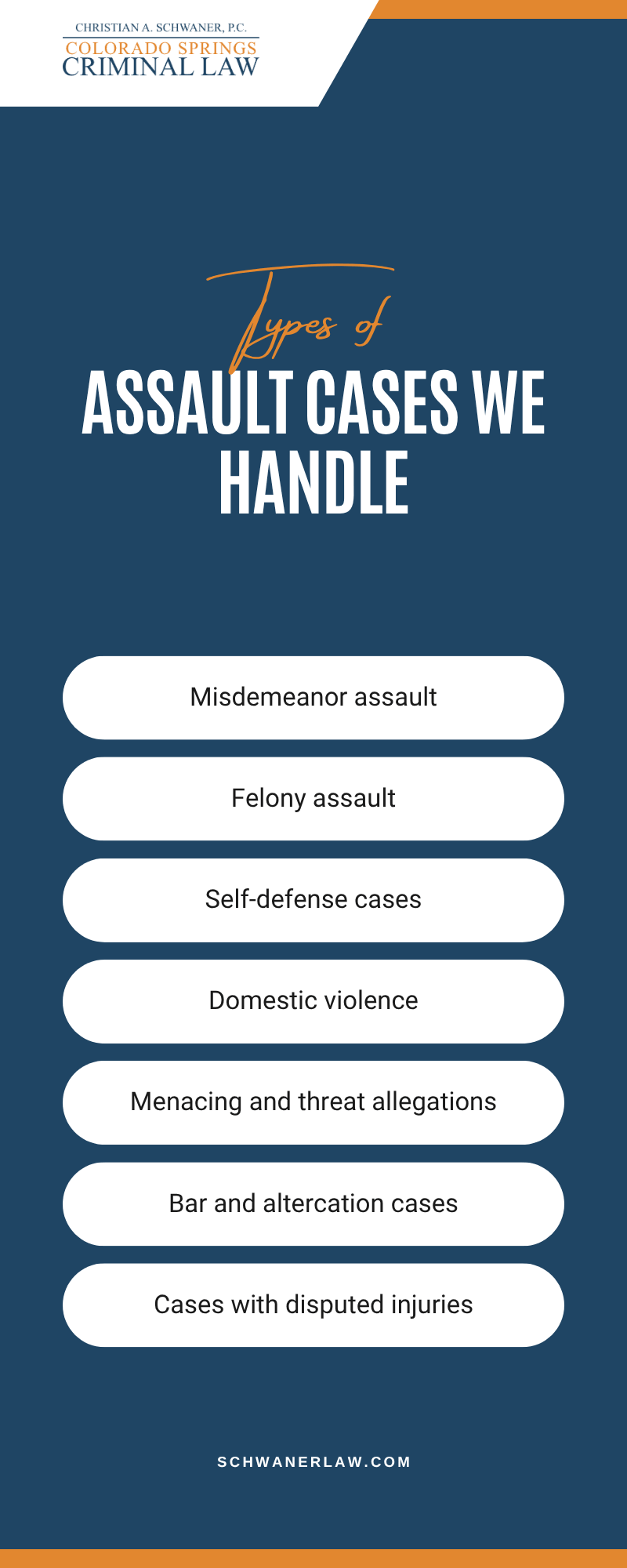
Types of Assault Cases We Handle in Colorado Springs
 Assault charges come in many forms, and the right defense depends on the specifics of the incident. Some cases involve minor injuries and heated words. Others involve serious harm or allegations of a weapon. These are the matters we handle most often for clients across the Colorado Springs area.
- Misdemeanor assault. Lower-level assault charges still carry real consequences and a record. We examine the injuries, the witnesses, and the context, and we look for the gaps in the state’s account. A misdemeanor is not minor when it sits on your record for good.
- Felony assault. Serious-injury allegations and weapon-related claims raise the stakes considerably. We bring trial-tested defense to these higher-level charges. The difference between a felony and a lesser charge often turns on disputed facts we work hard to develop.
- Self-defense cases. Many assault charges arise when someone defended themselves or another person. We build the record needed to show what really happened. Colorado law recognizes the right to self-defense, and we make sure that right is part of your case.
- Domestic violence. When an assault carries a domestic violence designation, it brings added consequences and conditions. We handle both layers together. These cases move fast and demand early attention.
- Menacing and threat allegations. Charges involving threats or intimidation can rise to felony menacing when a weapon is alleged. We treat these with the seriousness they carry. Words spoken in anger are not always a crime, and context matters.
- Bar and altercation cases. Fights that start in public can become serious charges by the time police sort them out. We examine the witnesses and the sequence of events. The person who ends up charged is not always the person who started it.
- Cases with disputed injuries. Some assault charges rest on injuries whose cause or severity is unclear. We scrutinize the medical evidence and the timeline. What the report claims and what the evidence shows are not always the same.
Every case turns on its own facts, and the strategy follows from a close look at the evidence rather than the label on the charge.
Why Choose Christian A. Schwaner, P.C. as my Assault Defense Lawyer in Colorado Springs, CO?
 A Former Prosecutor’s Perspective
Attorney Christian Schwaner has defended assault and other criminal cases in Colorado for more than 20 years. Before that, he served as a Deputy District Attorney in El Paso and Teller Counties, prosecuting violent-crime cases for the state. He knows how these charges are built, which evidence the prosecution leans on, and where those cases tend to fall apart. That experience carries into our work as a criminal defense lawyer in Colorado Springs, CO. There is real value in hiring a former prosecutor who has stood in the other chair.
Trial Experience and Honest Counsel
We prepare every case as if it could go to trial, because that preparation often produces the best result whether or not it does. A prosecutor who knows your attorney will actually try the case tends to evaluate it more carefully. As a prosecutor, Mr. Schwaner was twice recognized for trying more cases than anyone else in his office. He’s a member of the Colorado Bar Association and the Colorado Criminal Defense Bar. We give realistic assessments rather than false promises, and our consultations are free.
Understanding Assault Cases
 Charges, Penalties, and Defense Strategies for Assault Cases
You don’t need to know the criminal code to understand how an assault case works. A few ideas frame almost every one:
- A range of severity. Colorado assault charges run from misdemeanors to serious felonies depending on the alleged harm and circumstances.
- Weapons raise the stakes. Allegations involving a weapon can elevate the charge significantly.
- Self-defense is a real defense. The law recognizes the right to protect yourself and others.
- Context matters. Who started the incident, and what each person did, can change everything.
- Defenses exist. Conflicting accounts, weak evidence, and questionable injuries all create room to fight.
Our work begins with the strongest available criminal defense strategies for the facts in front of us. Sometimes the path runs through the evidence; other times it runs through the reasons a prosecutor drops charges when a case proves weaker than it looked. We pursue whichever route gives you the best outcome.
What Are Important Aspects of an Assault Case?
The outcome of an assault case often turns on details that aren’t obvious from the police report, and we give those details close attention.
- Who instigated the confrontation and what each person did.
- Whether self-defense or defense of another applies.
- Whether the injuries match the account that police recorded.
- Whether the witnesses are consistent and credible.
These factors can decide whether a case results in a conviction, a reduction, or a dismissal. We examine each one rather than taking the state’s version at face value, and witness impeachment is often part of that work.
What Is The Assault Case Timeline?
An assault case moves through a recognizable sequence, though the pace depends on the severity of the charge. Knowing the stages helps you prepare for what’s coming.
- Arrest and the filing of charges.
- Early court appearances and conditions of release.
- The exchange of evidence and investigation.
- Motions, negotiation, and case development.
- Resolution by plea, dismissal, or trial.
The early decisions often shape the outcome, which is why getting counsel involved quickly matters. Understanding the case timeline helps you make informed choices at each stage rather than reacting under pressure, and it lets us spot opportunities to resolve the case favorably before it ever reaches a jury.
What Should You Bring to Your Assault Consultation?
The more you bring, the more useful our guidance can be. If you have these, bring them to the first meeting:
- Any arrest or charging paperwork.
- Names of witnesses and a sense of what each saw.
- Photographs of any injuries, yours or others’.
- A written account of the incident while it’s fresh.
Expect a frank conversation about your options. We’ll explain how the state may approach the case and the available defenses that may apply to your situation.
What Are Important Colorado Legal Resources for Assault Cases?
 You shouldn’t have to navigate the system alone. These public resources can help you understand the courts and laws involved in a Colorado assault case.
- The Colorado Revised Statutes contain the state’s criminal laws.
- The El Paso County self-help center provides Fourth Judicial District court information.
- Statewide Colorado court self-help resources offer forms and guidance.
- The criminal appeal process is outlined for those reviewing a result.
Reach Out to Christian A. Schwaner, P.C. to Schedule a Consultation
An assault charge is serious, but it is also defensible, and you have time to mount a real defense. We offer free consultations and will give you an honest read on your case, including whether self-defense or a weakness in the state’s evidence puts you in a stronger position than you think. Contact us to speak with a Colorado Springs assault defense attorney who has handled these cases from both sides of the courtroom.
Colorado Springs Assault Defense Infographic
Assault Charge Statistics in Colorado Springs
 Statewide, Colorado Crime Stats tracks aggravated assault as one of four main violent crime categories reported by law enforcement agencies through NIBRS. Federal data from the BJS violent crime topic page classifies assaults as either aggravated or simple, with severity ranging from minor threats to near-fatal incidents. Not every arrest becomes a conviction. Cases get dismissed, reduced, and resolved through negotiation across every level of the system, and the outcome often turns on the strength of the evidence rather than the label on the charge.
Types of Evidence Used in Assault Cases
Assault cases are built and defended on evidence. Every case starts with what the state has and what the state can prove. Understanding the categories of evidence commonly used in these cases helps you understand what the defense actually looks like.
- Physical injury evidence. Photographs of injuries, medical records, and expert testimony about the cause and severity of the injuries all sit at the center of most assault cases. What the report describes and what the medical evidence supports are not always the same thing, and the distinction between minor and serious bodily injury often controls the level of the charge.
- Video footage. Bodycam and dashcam recordings, surveillance video from businesses, doorbell cameras, and cell phone recordings taken by witnesses all come into play. Video that supports the state’s account often does the work of multiple witnesses. Video that contradicts the state’s narrative can end a case entirely. The completeness of the video record has to be tested through discovery.
- Witness statements. People at the scene rarely see the same event the same way. Alcohol, adrenaline, and personal relationships all shape what witnesses remember. Prior statements to police, statements at trial, and statements between witnesses all get examined for consistency. The defense often works from the seams between accounts.
- Statements by the defendant. What you said to police, to the alleged victim, to friends, or online carries real weight. Voluntary statements are difficult to exclude later, which is why the offense of lying to the police is charged separately from whatever brought officers to you in the first place. The rule against self-incrimination protects the defendant only if it is actually exercised.
- Physical scene evidence. Broken glass, damaged property, blood spatter, and the positioning of items in a room can support or contradict the accounts given by the parties. Evidence obtained through searches conducted without a warrant or without valid consent can be challenged. Suppression of scene evidence under 4th Amendment rights can shift the balance of a case dramatically.
- Weapons and forensic evidence. When a weapon is alleged, the defense examines whether the item actually qualifies as a deadly weapon under the statute, how it was seized, and what forensic testing was done. The presence or absence of a weapon can shift a charge between misdemeanor assault, felony assault, and felony menacing charges.
- Digital evidence. Text messages, social media posts, location data, and phone records increasingly feature in assault cases. This is especially true when the parties have a prior relationship, and it is nearly universal in cases involving alleged false accusations that arise during a divorce, custody dispute, or breakup. Digital evidence often tells a very different story than the account given to police at the scene.
- Prior incident history. Prior calls to the same address, prior protection orders, and prior charges against either party can affect how the case is charged and how it resolves. The full history informs both the prosecution’s strategy and the defense’s response.
Colorado Springs Assault Defense Lawyer FAQs
 What is the difference between misdemeanor and felony assault in Colorado?
Colorado grades assault by degree. Third-degree assault is generally a misdemeanor covering knowing or reckless conduct causing bodily injury. Second-degree assault is a felony, often charged when a deadly weapon is alleged or when serious bodily injury is caused knowingly. First-degree assault is the most serious felony level, involving intent to cause serious bodily injury or the use of a deadly weapon. The classification depends on the alleged injury, the mental state the state can prove, and whether a weapon was involved.
Can I claim self-defense in a Colorado Springs assault case?
Yes. Colorado law recognizes the right to self-defense, defense of others, and defense of premises as affirmative defenses. Properly raised, these defenses can lead to acquittal even when the underlying physical conduct is not disputed. What matters is whether the force used was reasonable under the circumstances and whether the defendant was the initial aggressor. Building the record for a self-defense theory usually begins with the timeline, the injuries on both parties, and the witness statements.
What happens if the alleged victim doesn’t want to press charges?
Charging decisions in Colorado belong to the prosecutor, not to the alleged victim. The state can pursue charges even when the alleged victim expresses no interest in cooperating, particularly in domestic violence cases where a mandatory arrest and immediate protection order often follow the initial call. A reluctant witness can affect the prosecutor’s willingness to negotiate, though. That dynamic is often part of a resolution.
What is domestic violence assault and how is it different?
Colorado treats assault against an intimate partner or household member as a domestic violence offense with additional sentencing consequences, mandatory arrest procedures, and an immediate protection order. The underlying charge does not change, but the enhancement adds layers of consequences that make domestic violence charges distinct from other assault matters in how they resolve.
Can an assault conviction affect my gun rights?
Yes. Federal law and Colorado law both restrict firearm possession following certain convictions, and domestic violence assault convictions carry particular consequences under federal firearms law. A conviction on an underlying assault charge tied to a domestic relationship can create a permanent federal firearm restriction. The gun rights consequences reach past the sentence itself, affecting hunting, self-defense in the home, and any position that requires firearm carry.
What happens at the initial bond hearing after an arrest?
The bond hearing determines your conditions of release. In assault cases, and particularly in domestic violence assault cases, a mandatory protection order is issued at this stage. That order can affect where you live, who you can contact, and whether you can possess firearms. The bond amount, any electronic monitoring conditions, and the geographic restrictions all get set at this early hearing.
Should I refuse to give a statement to the police about the incident?
Generally, yes. You have the right to remain silent and the right to counsel. Exercising both is not a sign of guilt. Statements made at the scene, in an interview room, or over the phone often become the strongest evidence the prosecution has at trial. The state’s case can turn on details you did not realize were relevant at the time. The right to remain silent exists precisely because these moments are rarely the right time to speak.
Can an assault charge be sealed from my record?
Some assault records qualify for sealing under Colorado’s current statute. Dismissals, acquittals, and completed deferred judgments generally have the strongest sealing paths. Certain convictions may be eligible after a waiting period, though the framework for getting a criminal record sealed is more restrictive for violent offenses than for other categories. Long-term sealing goals often shape plea decisions from the start of the case.
What if I was defending someone else during the incident?
Defense of another is a recognized affirmative defense in Colorado. The elements are similar to self-defense, and the reasonableness of the force used is judged from the perspective of the person acting to defend the third party. Cases involving defense of family members, friends, or bystanders often turn on the timeline and the immediacy of the threat to the person being defended. The physical evidence and the witness accounts have to support the defense.
Can civilian assault charges affect my military service or security clearance?
Yes. Colorado Springs is home to several major military installations, and civilian assault charges filed here can create parallel military consequences for active-duty service members. Any pending charge or conviction can also trigger review of an existing security clearance, and even an unresolved arrest can affect renewal or upgrade decisions. Coordinating the criminal defense with the command notification and clearance review is often necessary in these cases.
Should I take the plea offer the prosecutor extended?
Not without a full review. Plea offers reflect the prosecutor’s assessment of the file, which may not match the actual strength of the state’s case once discovery is complete. A review of the evidence, the witnesses, and potential motions may reveal that the offer significantly undervalues the defense. It may also confirm that the offer is fair. Either way, the review has to come first. Accepting a plea without counsel closes off options that are difficult to recover later.
Local Information for Colorado Springs Assault Cases
 Colorado Springs Courthouses and Local Criminal Justice Resources
Assault cases in Colorado Springs are heard in the El Paso County Combined Court at 270 South Tejon Street, the largest single-facility courthouse in Colorado. Charges are prosecuted through the 4th Judicial District Attorney’s Office, which covers El Paso and Teller Counties. Defendants who cannot afford counsel may qualify for representation through the Colorado State Public Defender’s Colorado Springs office. Booking and pretrial detention run through the El Paso County Sheriff’s Office and the Criminal Justice Center on East Las Vegas Street. Colorado Springs Municipal Court handles certain lower-level offenses filed inside city limits, though most assault charges route to the combined court.
What Are Important Local Resources for Colorado Springs Assault Cases?
The resources below can help you locate the courts, prosecuting agencies, defenders, and detention facilities most often involved in a Colorado Springs assault case.
- El Paso Combined Court: (719) 452-5000
- 4th District Attorney: (719) 520-6000
- Colorado Springs Public Defender: (719) 475-1235
- El Paso County Sheriff’s Office: (719) 390-2000
- Colorado Springs Police Department (Non-Emergency): (719) 444-7000
- Colorado State Patrol Troop 2A: (719) 227-5400
Disclaimer: Christian A. Schwaner, P.C. provides this list of local resources for informational purposes only. Inclusion of any court, agency, or organization does not constitute an endorsement, and no affiliation between our firm and these entities is expressed or implied. Contact information can change and should be verified with each resource directly.
About Christian A. Schwaner, P.C.
Christian A. Schwaner, P.C. brings a prosecutorial background that extends beyond El Paso and Teller Counties. The firm’s founder also served as a Special Prosecutor in Pueblo and Canon City, giving him direct courtroom experience across multiple Colorado jurisdictions. He was named 2020 Best DUI Attorney in Colorado Springs by Expertise and holds membership in the National College of DUI Defense. His J.D. was earned in 1997, and he has been admitted to the Colorado bar continuously since that year. Free consultations are available for every new assault matter.
Christian A. Schwaner, P.C. DUI and Criminal Defense Lawyer – Colorado Springs Assault Defense Lawyer
729 S Cascade Ave, Colorado Springs, CO 80903
What Our Clients Say
⭐⭐⭐⭐⭐
Christian is an outstanding attorney. He went out of his way to get the best possible outcome for me. I called and bothered him often with several questions and he always had an answer for me. Somehow even though I was facing a pretty big charge I always felt better after talking with him. Christian is genuine and kind and someone you can trust.
— Nicole Thomas
Read more reviews on our Google Business Profile.
Contact Christian A. Schwaner, P.C.
 An assault charge in Colorado Springs sets serious deadlines in motion. Bond conditions, protection orders, arraignment, and discovery each affect what defenses remain available as the case progresses. Our free consultations give you a direct assessment of the charge, the evidence, and the realistic range of outcomes. Contact us to walk through the arrest paperwork, review the state’s initial case, and identify whether self-defense, evidentiary weaknesses, or a reduction path fits your facts.